
what is a
microhydraulic
actuator?
When an electric field distorts the shape of microscopic drops of liquid, a microhydraulic actuator converts that force into movement.
Structure of a microhydraulic actuator
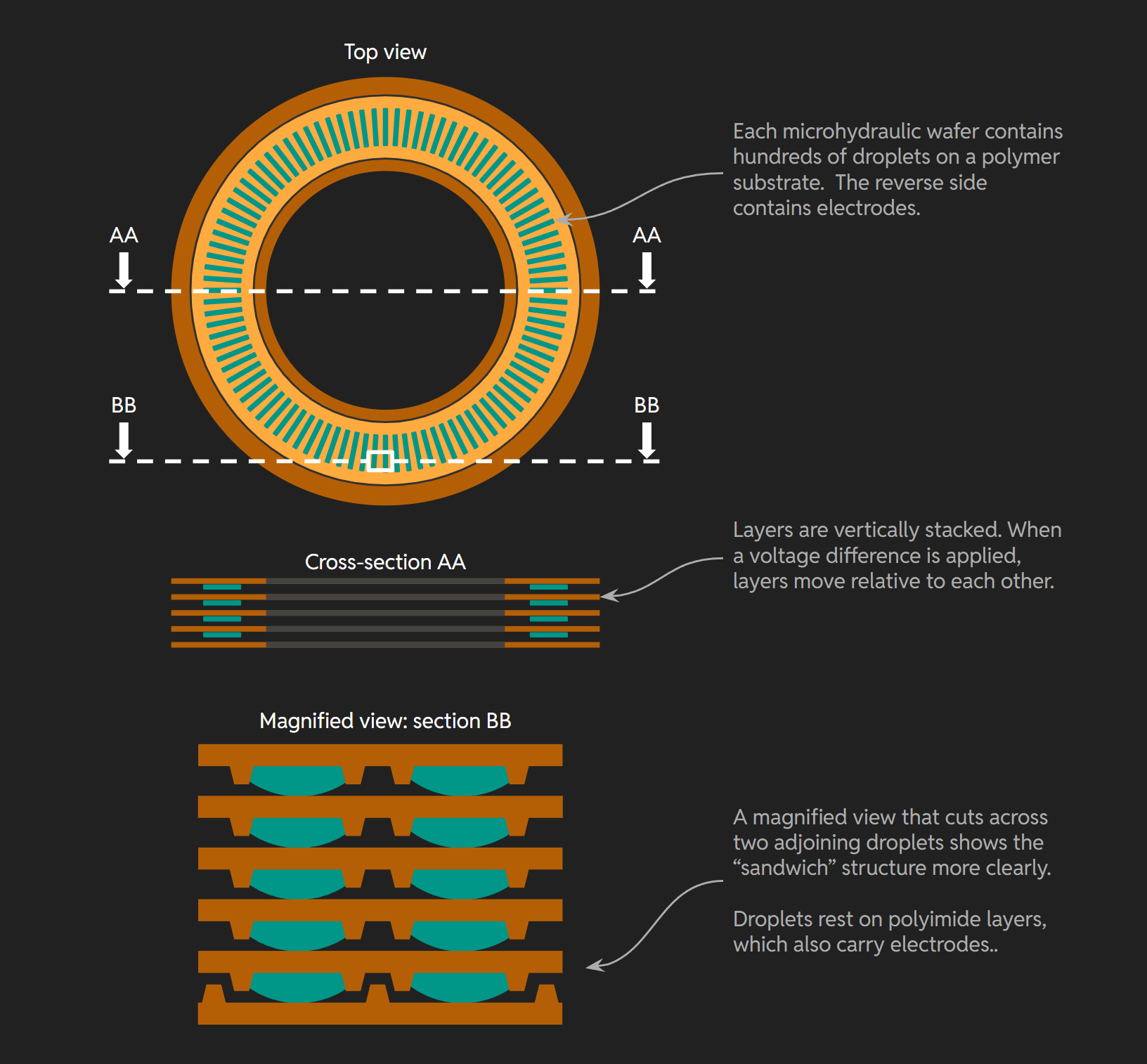
The more layers we stack, the more torque or force we generate.
This sketch is a simplified representation of figures 1 and 2 in:
Kedzierski, J., Chea, H.
Multilayer microhydraulic actuators with speed and force configurations.
Microsyst Nanoeng 7, 22 (2021). https://doi.org/10.1038/s41378-021-00240-7
"Superhuman" performance
Microhydraulic actuators are the only technology that operates in the lower right quadrant of a speed vs torque density graph, offering high torque density at moderate speeds — analogous to human joints.
Electromagnetic actuators provide high speed, but underperform on torque density.
The performance envelope of our actuators exceeds human joints today. We are pushing this envelope further, by packing more droplets into a single actuator wafer — to move from human capability to superhuman capability.
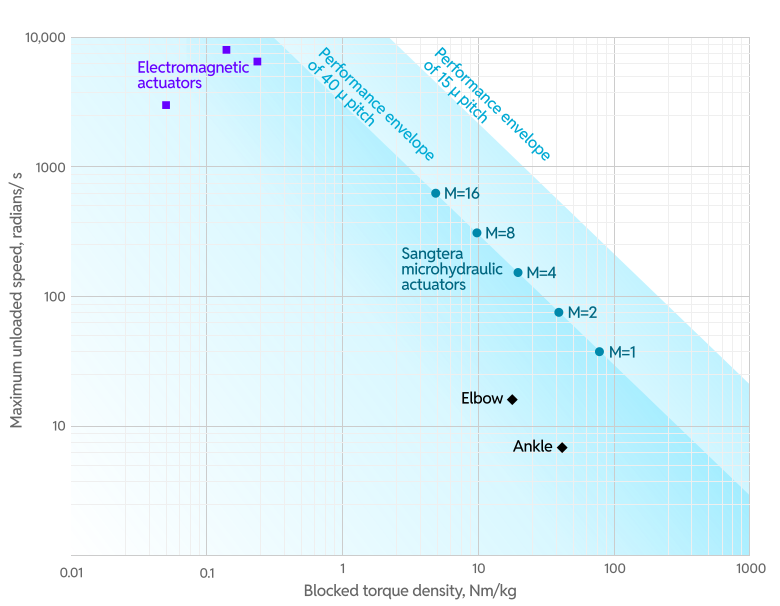
To trade off torque density for speed, configuration of a microhydraulic actuator has to be changed. This is indicated by M-values shown above. The M-value represents the number of layers pointing forward, alternating with equal number of layers pointing backward.
This graph is a simplified representation of Figure 6 in:
Kedzierski, J., Chea, H.
Multilayer microhydraulic actuators with speed and force configurations.
Microsyst Nanoeng 7, 22 (2021). https://doi.org/10.1038/s41378-021-00240-7